-
The diffraction
Work realized in 2005-2006 by:
Thierry DELANNOY (1°S5 euro) and Maxime DACHICOURT (1°S5)
1. Waves and waves...
The waves which are mechanical waves can undergo various physical phenomena when they meet obstacles. These obstacles can be due to a coastal relief (cliff, rocks, piers), in a change of hillside of the sea bed (estran sandy or rocky) or in openings of passage of waves enter of ports. These phenomena can be observed easily for the one who knows how to observe. It is necessary to know first of all that the marine waves can be identified to rectilinear and parallel waves, that is that two consecutive waves are regularly spaced out by a wavelength l:
 Fig.1
Fig.1When that they meet an obstacle it can happen three main phenomena according to the nature of the obstacle there:
2. The three main phenomena.
The mechanical refraction:
Refraction appears when rectilinear and paralleles waves arrive from a zone of deep water towards a zone of lesser depth where there is a sedimentation for example. These waves bend then and change direction.

The mechanical reflection:
Reflection can be observed when parallel and rectilinear waves arrive on a wall or quite other fixed obstacle preventing their progress. These are reflected and change direction of distribution and goes away from the obstacle whith the same angle.
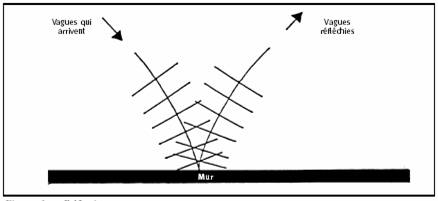
The mechanical diffraction:
There is a diffraction when rectilinear waves meet a wall, a dike... whith an opening of small size or by average size. In certain cases waves bend then and become round by way of this opening. They are not rectilinear any more but this time circulars:
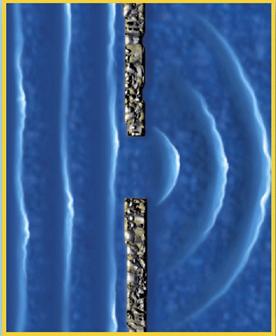
It is this phenomenon in which we were interested and which we wanted to verify. For it, we went on the beach of Boulogne sur Mer and with of small boards, we experienced to put in evidence these phenomena.
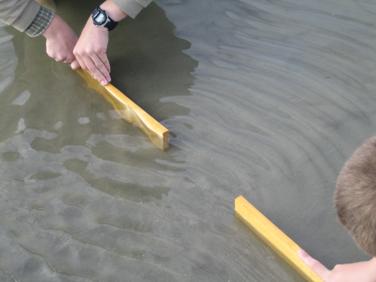
A first experience with a very small opening:
Positive experience! You can even see waves becoming round! The opening is small and the at first rectilinear wave, by way of this hole, becomes circular. The center of the hole is the center of the circular wrinkles. We mesure the wavelength : it is constant. The speed of wavelets stays the same.
Rectilinear and diffracted waves through the hole

The second experience with a wider opening:
Wavelets are a little less diffracted. Waves remain rectilinear in the center of the hole but they diffract on edges.
Rectilinear waves in the middle of holes and a littled bit round off later.
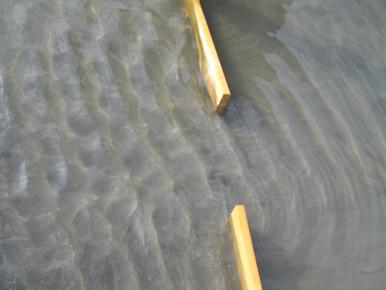
The third experience with an even wider opening:
In that case, we notice that wavelets are not animore diffracted by the opening, the crests of waves remain paralleles. The wavelength is always the same. We notice that there is all the same a small diffraction on the edges of the obstacle.
Rectilinear waves in the middle and diffracted waves on edges.
The conclusions of our observations and measures:
For all these experiences, we noticed that the wavelength of waves before and after diffraction is constant, that is that the distance separating two waves keeps. The speed of waves did not thus change.
Animations recapitulating these phenomena : one of her allows to choose the opening of diffraction and the wavelength of waves.
Addresses belowhttp://www.msu.edu/user/brechtjo/physics/interfaceOptics/interfaceOptics.html
http://www.ngsir.netfirms.com/englishhtm/Diffraction.htm
3. The consequences on the natural environment
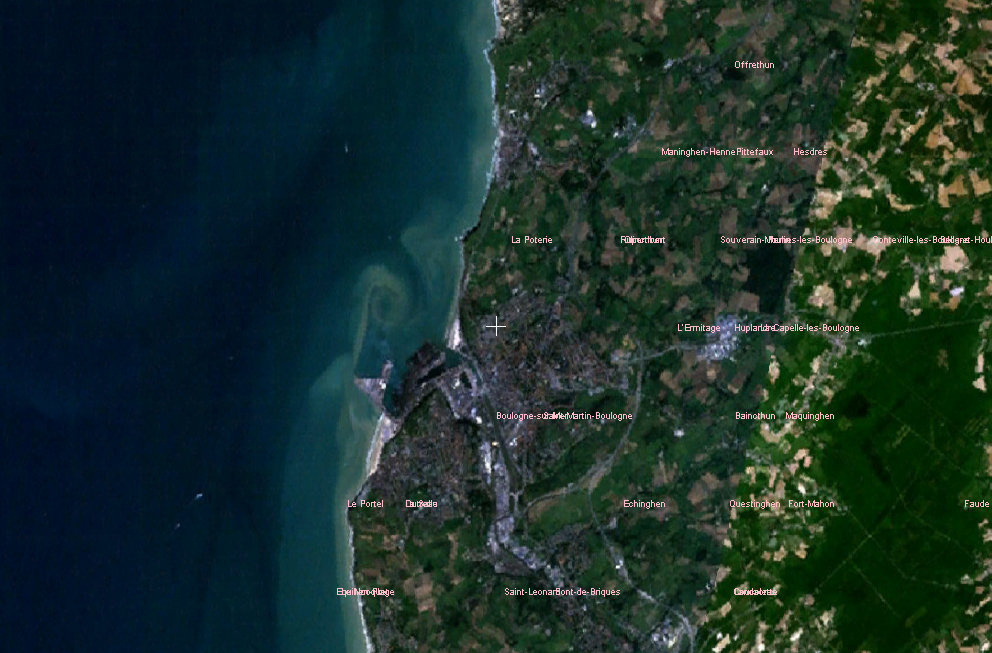
The phenomenon of the diffraction has several consequences on the shape of the coastal relief . It create a deposit of divers sediments behind the obstacles: rocks, piers, cliffs and thus contribute to the modelling of the coastal landscape. We know well this phenomenon in our region with the presence of the Gris nez which is responsible for the phenomenon of " Poulier ".
Sedimentation in the angle of the Port of Boulogne sur Mer.

Lexicon:
A wave is a distribution of energy, engendered by a disturbance, which produces on its passage a variation of the local physical properties.
Refraction, it is the chengement of the direction of distribution of a wave when this one changes environment.
When a wave reaches an obstacle, a part of the wave is reflected; the angle of reflection is equal to the angle of incidence.
Diffraction is the distribution of a wave by an object. The diffraction has for consequence the formation of the disk of Airy in the center of an optical instrument.
Wavelength is the distance separating two successive crests of a periodic wave. We denote it collectively by the Greek letter (lambda). Mathematically, we can define it so: if the wave can be represented by a periodic function f which takes as argument the distance x, then the wavelength is the smallest interval l such as for everything x, we have:
F =( x+l ) f (x)
By analogy with the homonymous mathematical notion, we name it sometimes improperly period. In physics, the period is the temporal equivalent of the wavelength l:la period is the minimal time which passes by between two identical rehearsals of the wave in the same point.
Forming of a deposit by gravitation of solid particles in a zone of the fluid in which they were in suspension. This deposit characterizes sediments.
 Wave
Wave